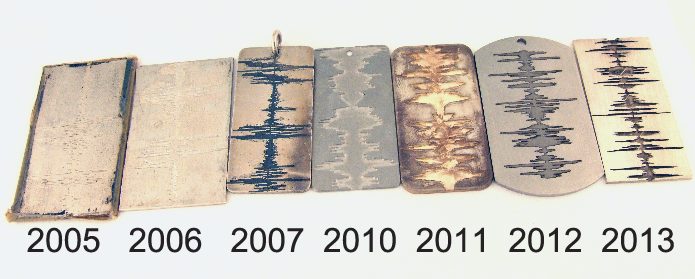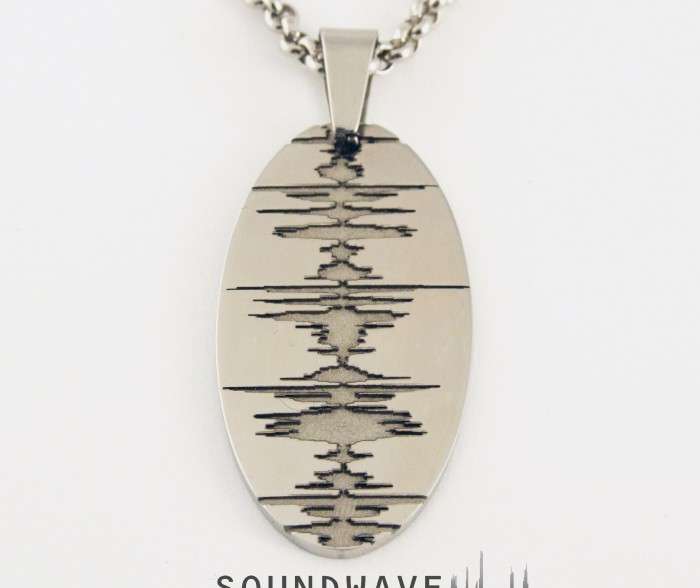
I've been working on the Soundwave Dog Tag for years. Only recently did the right technology come along to allow my vision to be fully realized. The challenge was always related to the depth of the etching. In order to colour the sound wave the etching has to be deep enough so when the entire piece is coated with the colour it is able to be removed off the surface without damaging the sound wave.
When I first started creating Soundwave Dog Tags I used a photo transfer process. The first sample created a really beautiful etching, not so deep but super sharp. The main issue was it is only achievable using nitric acid, not a pleasant material to have around. I moved onto a less harsh chemical, ferric nitrate. I found it hard to create the right mixture. If it was too weak the etching wouldn’t be deep enough, too strong and it would eat through the photoresist. I solved the problem by using the transfer paper to outline the design and then painted the outline of the sound wave carefully with a shellac. The photo paper was very hard to adhere to the surface of the metal and as you could imagine painting the entire outer edge of the sound wave was extremely time consuming.
I created the dog tag this way for a couple years, the time involved made these projects truly a labour of love. I had to find another way if I wanted to continue to create them. I briefly experimented using an industrial metal etching company. They could get the depth but could only etch material 0.8mm in thickness. I like the Dog Tag to be at least 1.1mm in thickness, this is not negotiable. I tried some samples using Cad/Cam technology and lost wax casting but the cost of the process was prohibiting. I was looking to make the Dog Tags an affordable gift item. Something special for a life’s event that doesn’t involve a ring. Around this time laser technology was getting really hot and being introduced to the jewellery industry through laser welders. I started experimenting with laser engraving.
The laser engravers in the jewellery industry looked super clean but still couldn’t achieve the depth I wanted. Eventually I found a laser intended for more industrial uses that was able to get the job done. Our first sample was actually too deep and left the piece at risk of bending and snapping in half. After a couple more try we were able to find the right depth.
Creating the perfect Soundwave Dog Tag has taken years. With the introduction of new technology I was able to achieve the quality I wanted and offer an affordable price point to my clients. Quality is of upmost importance to me and something that can not be compromised. For me the greatest feeling is being able to proudly stand behind my work knowing that every step was taking to insure the jewellery I create lasts lifetimes.
Record.Create.Express.
Watch the crowd in this video make a live soundwave
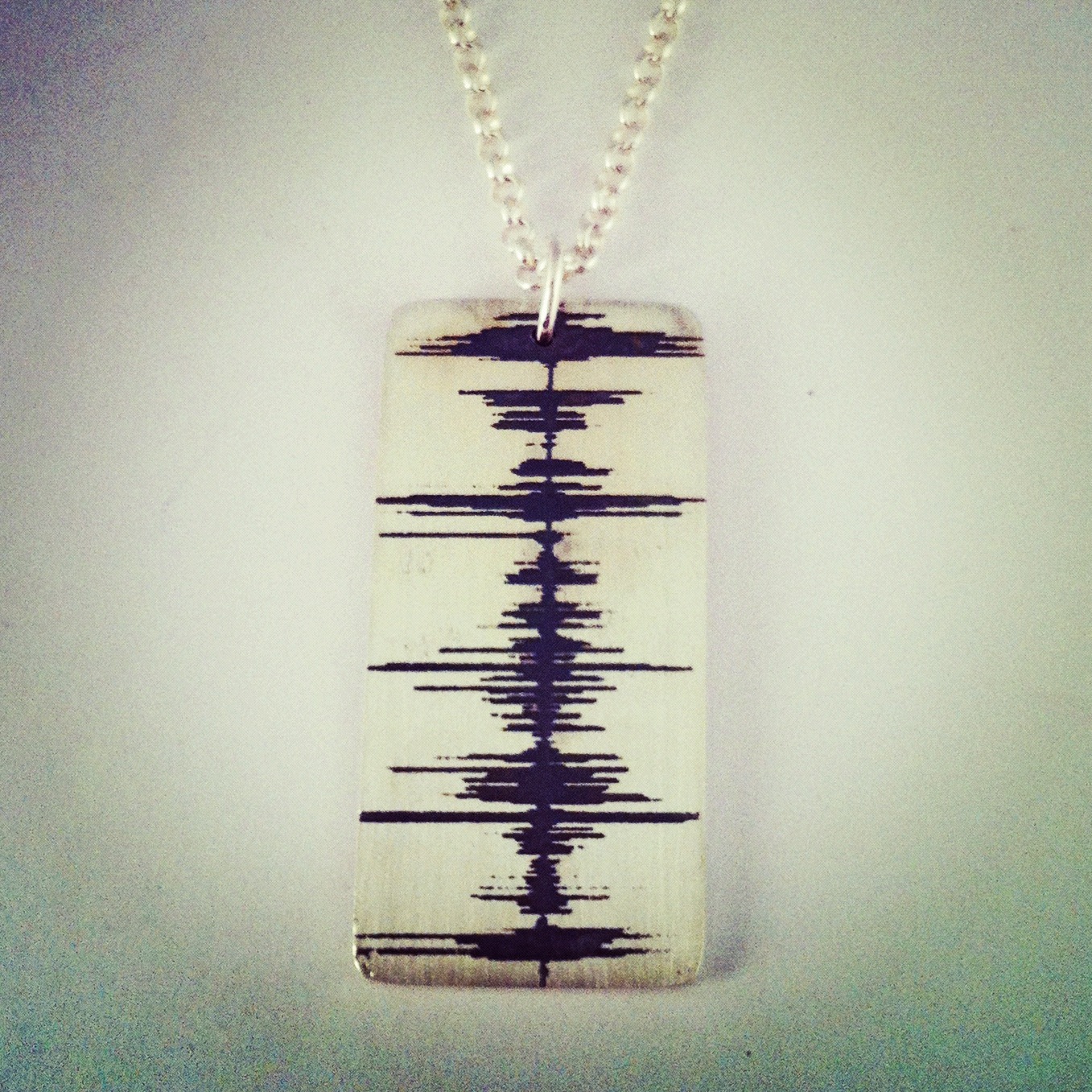
Custom Soundwave Dog Tag
Milo's first words
It is always a special treat when clients are able to make it into the recording studio. While not a necessity it allows me to monitor the recording process and offer some tips on how to achieve the most aesthetically pleasing sound wave.
For the piece above I had the pleasure of welcoming baby Milo and his Mom to the studio. This custom men's dog tag was created for his father. Milo needed little instruction as he sat on the floor and began chewing on the mic. As I often do I stepped out of the room to give my clients some privacy and make them feel a little more relaxed. However this time I couldn't help peaking in to witness this little guy make his first recording. He was a bit shy at first but within five minutes we had tons of material and the perfect sound wave for his father to wear with pride.
It excites me most to think that one day baby Milo will be all grown up and be able to see his first sound wave. If he's lucky his father might pass this piece of jewellery onto him. I might be biased but in my opinion this is way better then a pair of bronzed baby booties.
This man's work is truly incredible and inspirational. The video below is his feature on Make. Check out his the videos of waves in action on his website: http://www.reubenmargolin.com/
"Reuben Margolin, a Bay Area visionary and longtime maker, creates totally singular techno-kinetic wave sculptures."
At the beginning of this year Soundwave Jewelry was feature in this article by Bill Taylor regarding wedding band trends.
Check it out!
Back to Wedding ring trends for 2012: Personalized bands
January 26, 2012
Bill Taylor
A hundred years from now, your great-granddaughter comes across your wedding ring in an old jewellery box.
As she admires it, she wonders what her great-grandfather might have said to his bride-to-be when they were young and full of hope for the future.
So she rolls the ring across an ink-pad and then across a sheet of paper, which she then scans into her laptop. A little digital manipulation and, across the century, her forebear speaks to her!
This is designer Danielle Crampsie’s “Soundwave Ring,” a wedding band that boasts something even Prince William’s bride, Kate Middleton, doesn’t have on her ring: A voice.
When Crampsie is designing rings for a couple, she can record either their voices pledging their love (or whatever) or a favourite piece of music. She then prints a computer read-out of the sound wave and engraves it on the jewellery.
“It becomes living history. It’s a piece of you that will endure,” says Sarah Hamel, who runs Made You Look, a Queen St. W. shop that provides workspace for about 20 self-employed jewellery designers, including Crampsie, and sells jewellery from more than 100 local designers.
These are not your great-grandmother’s wedding bands!
• Deborah Lavery will etch you and your spouse-to-be’s fingerprints onto each other’s ring.
• Zsolt Szekely combines gold and cocobolo wood into rings that are distinctive and durable. “Cocobolo has about the same wear-rate as gold and better than silver,” says Hamel, adding it’s cheaper than an all-gold band.
• Jon Pollack works with titanium and Delrin, a robust plastic compound used in joint-replacement surgery and available either in black or white.
• Andrea Golden uses the 17th-century Japanese technique of mokume-gane to create intricate laminates of different metals.
“Those are just a handful of examples,” says Hamel. “We encourage clients to pick a designer and meet with them before they commission a piece.
“It’s not so much following trends or even creating trends. But we want to break down old-fashioned ideas.”
Two of Crampsie’s clients are just leaving, both giving her a warm hug. They’re musicians, she says, and their rings will have sound waves “one an octave higher than the other.”
Her earrings are sound waves, too, for a line from a song: “On a bus full of empty seats, who wants to sit with me?”
Rising gold prices mean more people are choosing composite rings, Hamel says, or bringing in “old gold, passed on from various family members that they want turned into something.”
Wedding bands don’t have to be flashy, she says. “Something with a sound wave or fingerprint etching is purely for the couple. It’s special.”
Nor do the rings have to match.
“There may be a little anxiety if one wants one thing and the other something different. But you can have two completely different rings made by the same artist, or have something engraved that links the two.
“Our customers tend not to have the old-school mindset. They regard it as buying a little piece of art. We find, too, that where engagement rings seem to be all about the girl, with wedding bands, it’s the guy’s chance to express himself.”
Birks, which has 35 stores across Canada, has rings starting at about $600, says spokesperson Eva Hartling, and rising to the high side of $100,000.
“But that would be for an eternity-style ring with diamonds all the way around,” says Hartling from Birks’ Montreal headquarters.
Price is definitely a factor for most customers, with some opting for platinum over gold. Men, especially, are also choosing silver or titanium, she says.
“With gold bands, women are going back to slimmer styles; much slimmer than, say, the late ’90s, early 2000s ,” Hartling adds. “That’s partly for economic reasons.”
With fashion jewellery, she says yellow gold — more typical of the 1970s — is starting to make a comeback. But there’s no sign yet of that being the choice for wedding bands. “White gold has been the choice for more than a decade.”
Some women want a wedding band with a stone. Styles include micro-pavé, with the ring literally “paved” with tiny diamonds, and large pavé, with bigger but fewer stones.
Hartling says most couples go for different style bands, especially if the woman’s has a stone. Same-sex couples tend to choose matching bands.
As for Kate Middleton’s ring, it hasn’t had much impact here. Nor has Prince William’s decision not to wear a ring.
“That’s Europe versus North America,” Hartling says. “North American men traditionally wear a wedding band.”
Choose wisely
A wedding ring is more than just a simple band of gold. Sarah Hamel offers tips on choosing the right one:
• For a gold ring, budget about $1,000 for the metal alone. Depending on size and weight, it may be more or less, but that’s a realistic starting figure.
• Try on a lot of rings. Just like clothes on the rack, rings that look good at first may not suit you when you try them on.
• Men who have never worn a ring before may “gravitate toward something chunky.” Hamel warns them they need to be comfortable carrying a bunch of grocery bags with their wedding band on.
• Don’t worry about what styles other people are wearing. Go with what works for you.
• Don’t go too wild with your design ideas. Hamel says wedding bands follow certain formulas for a reason. “If you want a crazy fashion ring, come back later and we’ll talk!”
— Bill Taylor
http://www.thestar.com/living/article/1121795--wedding-ring-trends-for-2012-personalized-bands